International Morse Code: The Complete Beginner's Guide
You are stuck. It’s an emergency, and you need some assistance. Your phone died, the connection is down, and the only hope for survival lies in your ability to send an SOS signal consisting of three short dots, followed by three long dashes, then another three short dots. Yes, this is international Morse code used for saving lives on several occasions.
Other than being an effective method of communication for emergency situations, Morse code is utilised by pilots, navy personnel on a regular basis, by ham radio enthusiasts across the globe, and the best thing is that it is simple to learn.
You want to learn more about the code, get your messages decoded, or want to send your messages using Morse code. Everything that you need to know about Morse code is mentioned in this guide. Our Morse code translator does the job within seconds.
What Is International Morse Code?
International Morse code is a standardised system that turns letters, numbers, and punctuation into a series of dots and dashes. Each dot is a short signal. Each dash is three times longer than a dot. The gap between parts of one letter is one unit. The gap between letters is three units. The gap between words is seven units.
That timing is everything. Get it right, and your message is crystal clear. Get it wrong, and the whole thing falls apart.
The system works across sound, light, radio waves, and even physical taps on a surface. No electricity required. No internet needed. Just a rhythm anyone on the receiving end can decode.
Today, it is recognised globally as the standard for Morse code communication. Aviation, maritime, and amateur radio all operate using this same system. It is the version you will find on every official frequency table and the one you need to learn if you want your signals understood anywhere in the world.
American Morse Code vs International Morse Code
This is one of the most searched comparisons around Morse code, and the confusion is completely understandable. Both systems use dots and dashes. Both were created by the same person. But they are different in ways that actually matter.
American Morse code was built for early American telegraph lines. International Morse code was built for the world. Here is what actually separates them.
Feature | American Morse Code | International Morse Code |
Year Developed | 1844 | 1848 |
Dash Length | Inconsistent, varies by letter | Uniform across all letters |
Character Spacing | Uses short pauses within letters | No internal spaces within letters |
Complexity | Higher, more room for error | Simplified, standardised |
Global Adoption | Used mainly in North America | Official ITU standard worldwide |
Still Used Today | Historical reference only | Active use in radio, aviation, and maritime |
Take the letter O as an example. In American Morse code, it is represented as a dot, a space, then two more dots with unusual internal spacing. In international Morse code, it is simply three dashes: —. Clean. Consistent. No ambiguity.
American Morse code suited the equipment of the 1840s. The early telegraph machines had quirks that required that kind of variable timing. However, as the use of radios expanded and the need for international standards emerged, the American version became outdated outside America. Nowadays, it survives only as an object of study for those who wish to know its history.
The International Morse Code, on the other hand, is the only one worth memorising. All manuals, all teachers, and all radio operators around the world use it.
International Morse Code SOS: The Signal That Saves Lives
The Morse Code SOS is undoubtedly the best-known signal in the world. Three dots, three dashes, and another three dots make this signal. In written format, it appears as follows: …—…
Now, there’s an interesting piece of information that most people do not know about this signal. Contrary to what many believe, SOS does not mean “Save our Souls” or “Save our Ships.” The phrases were simply used for memorisation purposes after the signal was adopted in 1908 for its other feature, which is ease of transmission.
Three short taps. Three long ones. Three short again. Anyone can do that with a flashlight, a rock against a pipe, a whistle, or a radio key.
The signal is sent as one continuous unbroken sequence with no gaps between the S and the O. That is what makes it a prosign rather than three separate letters. It stands alone as a single distress call.
How to signal SOS without any equipment:
- Tap three times quickly on any hard surface
- Pause for a beat
- Tap three times slowly
- Pause for a beat
- Tap three times quickly again
- Repeat until someone responds
You can do the same with a flashlight, a mirror reflecting sunlight, or a whistle. Short, long, short. That is the pattern. Anyone trained in international Morse code will recognise it instantly, and many people who have never studied Morse code will recognise it too because it is that well-known.
The International Morse Code Alphabet
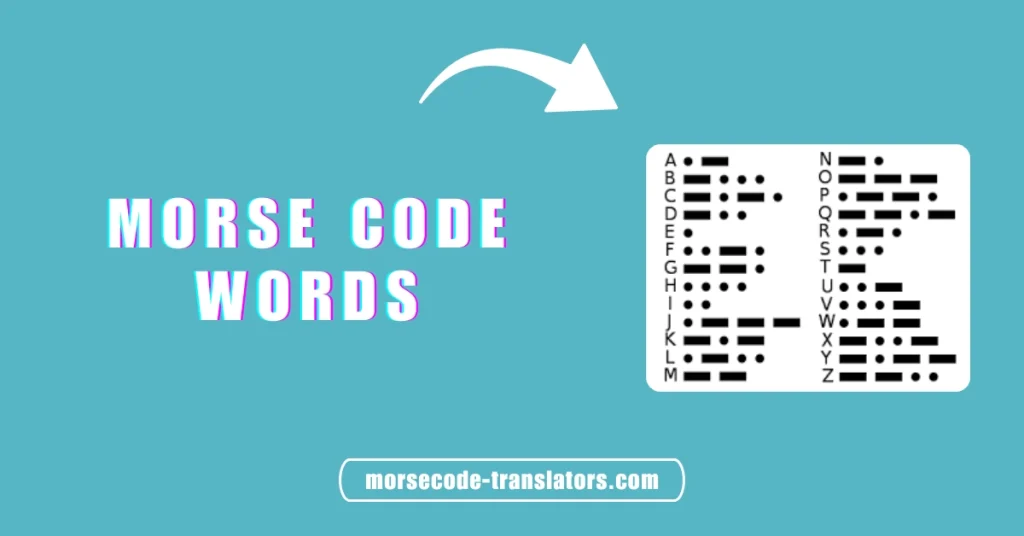
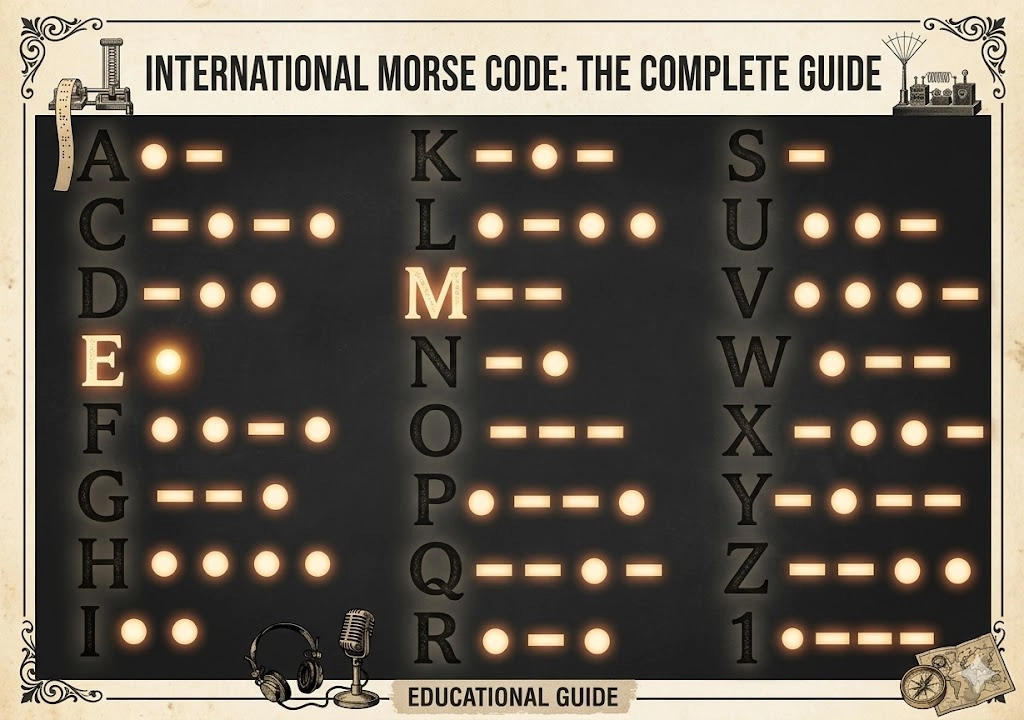
The Morse Code alphabet consists of all 26 alphabets in the English language. Each letter has a distinct combination of dots and dashes. There is no repetition of combinations for any letter in the Morse Code alphabet; this is the uniqueness of this method.
Start With These Letters First
If you are just beginning, do not attempt to remember all 26 letters together. Begin by learning the five most frequently used letters of the English language. You are bound to see these letters in your messages.
E is a single dot. Just one. The shortest signal in the whole system. T is a single dash. One long pulse. A is dot-dash. I is dot-dot. N is dash-dot.
These five alone will get you through a surprising number of short words. Once they feel natural, add S, O, R, and H.
The Full A to Z Table
Letter | Morse Code | Letter | Morse Code |
A | . — | N | — . |
B | — . . . | O | — — — |
C | — . — . | P | . — — . |
D | — . . | Q | — — . — |
E | . | R | . — . |
F | . . — . | S | . . . |
G | — — . | T | — |
H | . . . . | U | . . — |
I | . . | V | . . . — |
J | . — — — | W | . — — |
K | — . — | X | — . . — |
L | . — . . | Y | — . — — |
M | — — | Z | — — . . |
Take a few letters at a time. Learn their sound, not just their shape on paper. That distinction matters a lot, and there is a whole section below that explains why.
International Morse Code Numbers
Numbers in international Morse code follow a beautifully logical pattern. Once you see it, you will never forget it.
Every number uses exactly five elements. The lower the number, the more dots appear at the start. The higher the number, the more dashes appear at the start. One becomes mostly dashes by the time you reach nine.
Number | Morse Code |
0 | — — — — — |
1 | . — — — — |
2 | . . — — — |
3 | . . . — — |
4 | . . . . — |
5 | . . . . . |
6 | — . . . . |
7 | — — . . . |
8 | — — — . . |
9 | — — — — . |
Note that 5 consists of five dots, and 0 consists of five dashes. Every digit in between is just a transition from dots to dashes. Such a scheme makes Morse code numbers some of the simplest elements of Morse code to remember once you realize its logic.
Common Morse Code Words You Should Know
Learning full sentences takes time. But knowing a handful of common Morse code words gives you an immediate practical foundation. These are the ones worth memorising first.
Word | Morse Code |
Hello | . . . . / . / . — . . / . — . . / — — — |
SOS | . . . — — — . . . |
Help | . . . . / . / . — . . / . — — . |
OK | — — — / — . — |
I Love You | . . / . — . . — . — / . . . — . . . — — — . . — |
Yes | — . — . — / . — . . / . . . — |
No | — . / — — — |
In the above table, “/” refers to a word space that lasts for seven units during the real transmission process. In your studies, pronounce the words as sounds rather than pronouncing them from a paper using the symbol. This is the difference between a person who can read Morse code and one who knows Morse code.
Are you interested in how to express “Hello” in Morse Code or “I Love You” in Morse Code? Our translator handles both in seconds.
How to Learn International Morse Code Step by Step
Most people who try to learn Morse code quit within a week. Not because it is too hard, but because they start the wrong way.
Learn Sounds, Not Symbols
No need to focus on the chart of dots and dashes. Try listening. Each letter has its own rhythm. For instance, the letter C is pronounced “dah-dit-dah-dit,” and the letter K is pronounced “dah-dit-dah.” You will automatically decode them once you learn to recognise their rhythm without thinking about them as symbols.
Start With High-Frequency Letters
English uses some letters far more than others. If you learn E, T, A, O, I, N, S, and R first, you can already decode a massive percentage of common English words. Add H, R, D, and L next. Save rare letters like Q, X, J, and Z for later.
Use the Farnsworth Method
The Farnsworth technique sends each letter at full speed but slows down the space between letters and words. You can therefore hear each letter in its correct pronunciation without fail, although you will have additional time to decode it until the following character.
Practice With Real Words, Not Random Letters
Letters are meaningless and not easy to remember; therefore, try learning whole words and phrases right from the start. Start with simple words and then go up to phrases containing four words.

How International Morse Code Came to Be
Samuel Morse and his assistant Alfred Vail created the first working Morse code system back in the 1830s. The original version, later called American Morse code, got the job done for telegraph lines running across the United States. But it had problems. The dash lengths were inconsistent. Spacing between characters was uneven. Operators made mistakes constantly, especially across long distances.
In 1848, a German operator named Clemens Gerke reworked the whole system. He made the dash lengths uniform, cleaned up the spacing, and simplified the character set. His version was far more reliable and much easier to transmit accurately.
By 1865, the International Telegraph Union, now called the ITU, officially adopted Gerke’s version as the global standard. That decision changed everything. Suddenly, operators in Germany could communicate cleanly with operators in France, in Japan, and in South America. One code. One standard. The whole world on the same frequency.
During both World Wars, international Morse code became a critical military tool. Ships transmitted distress signals. Field operators sent coordinates. The SOS signal, which you will read more about below, became the universal cry for help that crossed every language barrier.
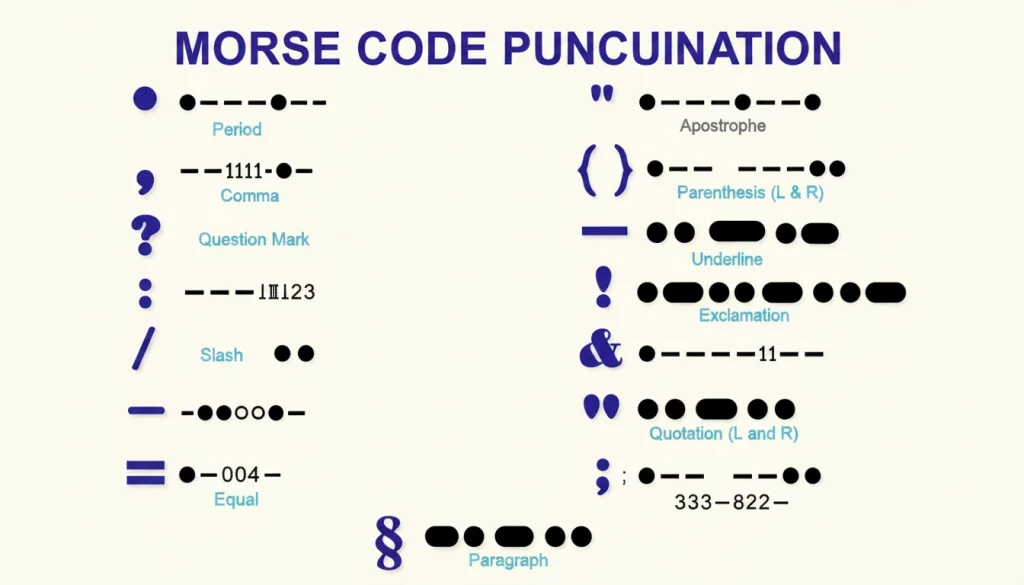
International Morse Code Punctuation and Symbols
Punctuation in Morse code consists of longer series of signals than either letters or numbers, but nevertheless, all punctuation marks are standard.
Symbol | Morse Code |
Period (.) | . — . — . — |
Comma (,) | — — . . — — |
Question Mark (?) | . . — — . . |
Apostrophe (‘) | . — — — — . |
Colon (:) | — — — . . . |
Slash (/) | — . . — . |
At Sign (@) | . — — . — . |
Hyphen (-) | — . . . . — |
Other than punctuation, there are also prosigns used in international Morse Code. These are special symbols created from two letters written as one without spacing. They include signals such as “Begin Receiving,” “End Message,” or “Wait.” One such sign is SOS, which is always transmitted as one long sequence of dots and dashes.
International Morse Code Day: Why April 27 Matters
International Morse Code Day is observed annually on April 27. This day is significant because it is the birthdate of Samuel Morse, who was born in 1791. Radio enthusiasts from different countries send messages in Morse code, activate special stations, and introduce beginners to the hobby.
This holiday is not simply a celebration of the past. It serves as a reminder that the technology created almost two centuries ago can still be used effectively and is still worth mastering. In an era when satellites malfunction and cellular towers are disrupted by natural disasters, knowing a language that does not require anything other than good timing is truly useful.
International Morse Code Practice Tips
Knowing the chart is the starting point. Getting the signals into muscle memory takes consistent repetition. These tips speed that process up considerably.
Keep sessions short and daily
Five to ten minutes every day outperforms an hour once a week. Consistency builds the pathways in your brain faster than volume.
Listen more than you read
The goal is to hear a signal and know the letter instantly, without mentally converting dots and dashes first. Passive listening while doing other tasks helps build this.
Find a practice partner
Amateur radio communities are full of people at every skill level who are happy to run drills. Live practice with another person accelerates your accuracy faster than solo training.
Use real-world phrases
Practice words you actually use. Weather reports, short news headlines, and common greetings. The more meaningful the content, the better it sticks.
Track your progress
Start at a comfortable speed and only increase it when you are accurately copying at least 90 per cent of what you hear. Pushing speed too early creates sloppy habits.
Mix sending and receiving
Do not just practice copying. Tap back what you hear. The physical act of sending reinforces what you have learned on the receiving end.
Final Thoughts
Learning international Morse code is not as complicated as it looks from the outside. Start with a few letters. Learn their sounds. Practice a little every day. Within weeks, patterns that look like random dots and dashes start speaking to you in plain English.
The world still uses this system. People still listen to it. And the day you need to send a message when every other option is gone, knowing even the basics could be the most useful thing you ever learned.
Ready to start? Use our Morse Code translator to hear any word or sentence in real Morse audio right now.
Frequently Asked Questions
What is the difference between American Morse code and international Morse code?
American Morse code uses inconsistent dash lengths and internal spacing within letters, making it harder to transmit accurately. International Morse code standardises all dash lengths and removes internal spaces, making it far more reliable.
Is international Morse code still used today?
Yes, actively. Amateur radio operators use it worldwide. Aviation still uses Morse code identifiers for navigation beacons. Maritime communication, military training, and emergency preparedness programs all include Morse code proficiency.
How long does it take to learn international Morse code?
Most people can decode simple words and short phrases within two to four weeks of daily practice. Reaching a comfortable conversational speed, around 13 words per minute, typically takes three to six months of consistent training.
What does SOS stand for in Morse code?
SOS does not stand for anything. It was chosen purely because the sequence, three dots, three dashes, three dots, is the simplest and most recognisable distress pattern possible.
What is the international Morse code for the number zero?
Zero is five dashes: — — — — —. It is the longest single character in the entire number set. All numbers use five elements, with zero being the only one made entirely of dashes.
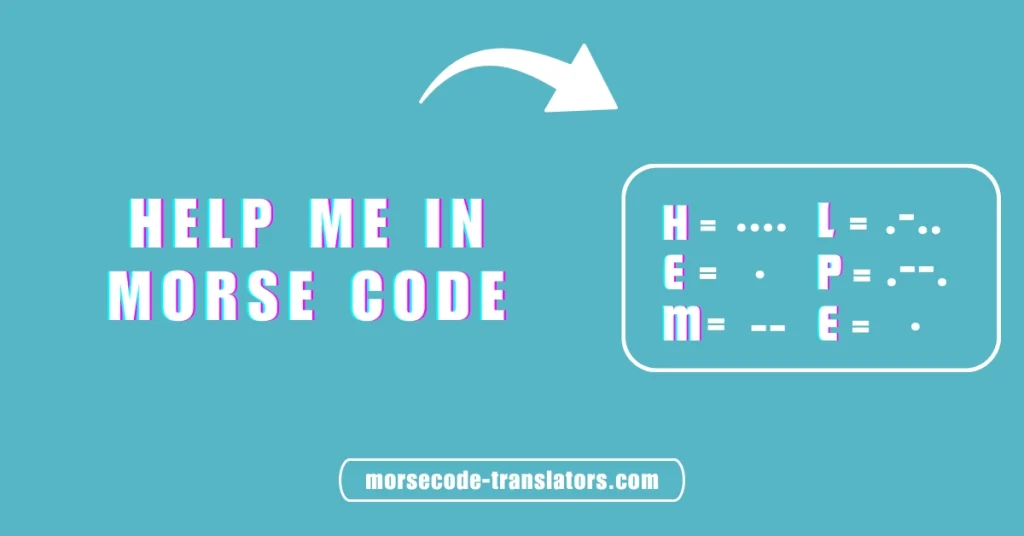
Can I use Morse code to send messages Help me?
Absolutely. The phrase help me in Morse code is …. . .-.. .–. / — . Type it into our translator, and you can hear exactly how it sounds. In a real emergency, that pattern tapped on any surface is internationally recognised.