How to Learn Morse Code: The Complete Beginner-to-Confident Guide
Most people who search for this topic are not historians. They are curious people who saw Morse code in a movie, heard about it from a radio hobbyist, or want a skill that actually works when technology fails.
Whatever brought you here, you are in the right place. This guide walks you through everything, from understanding the basic signals to tapping out your first real message. No fluff, no skipping steps.
You can also use our Morse Code translator to cross-check your work as you practice throughout this guide.
What Is Morse Code and Why Does It Still Matter
Morse code is a communication system that converts letters, numbers, and symbols into combinations of short and long signals called dots and dashes. A dot is called a dit. A dash is called a dah. That is the entire foundation of the system.
Samuel Morse developed it in the 1830s for telegraph communication. Operators would tap electrical pulses down a wire in specific patterns, and someone on the other end would decode the message. It worked across vast distances when nothing else could.
What surprises most people is that Morse code is still genuinely in use today.
Real-World Uses of Morse Code Today
Use Case | How Morse Code Is Applied |
Emergency Signaling | SOS sent via flashlight, whistle, or tapping on a surface |
Aviation | Airport navigation beacons still transmit Morse identifiers |
Amateur (Ham) Radio | Licensed operators communicate globally using Morse on HF bands |
Accessibility Technology | People with limited mobility use switch-based Morse input systems |
Military Operations | Used in situations where voice communication is not secure |
Art and Jewelry Design | Messages encoded in Morse appear in tattoos, pendants, and prints |
This is not a dead skill. It is a niche one, which makes it worth having.

How to Learn Morse Code Step by Step
This is the part most guides rush. The order in which you learn Morse code matters more than how fast you go. A structured path builds fluency. A random approach builds confusion.
Step 1: Start With the 10 Easiest Letters
Begin with E, T, A, N, I, M, O, S, R, and U. These are short codes, and they appear constantly in English text. Starting here means you can form real words almost immediately, which keeps practice interesting.
- E = · (one dot)
- T = – (one dash)
- A = · – (dit dah)
- N = – · (dah dit)
- I = · · (dit dit)
- M = – – (dah dah)
- O = – – – (three dahs)
- S = · · · (three dits)
- R = · – · (dit dah dit)
- U = · · – (dit dit dah)
Step 2: Learn Letters in Mirror Pairs
This technique shortens your learning time significantly. Certain letters are direct opposites in their pattern. When you learn one, the other becomes much easier to remember.
- E (·) and T (–) are the simplest possible opposites
- A (· –) and N (– ·) are mirror images of each other
- S (· · ·) and O (– – –) follow the same logic
Work through the remaining alphabet by grouping similar-looking patterns together. Do not try to memorise
the full alphabet in one sitting.
Step 3: Build Words Before Completing the Alphabet
After your first 10 letters, stop drilling isolated characters and start forming words. Short words built from what you know will solidify your recall faster than any flashcard session.
With just E, T, A, N, I, M, O, S, R, and U, you can already spell: man, tone, rain, mine, same, most, more, nose, route, name, train, steam, and dozens more. Practice encoding and decoding these before adding new letters.
Step 4: Add Numbers and Punctuation
Once you are comfortable with the full alphabet, bring in the numbers. The logical pattern from 1 to 0 makes this section easier than the alphabet. After numbers, add only the most common punctuation marks: period, comma, and question mark.
Step 5: Move From Reading to Listening
This is the most important transition in the entire learning process. Counting individual dots and dashes works at very slow speeds. At anything approaching normal speed, it becomes impossible.
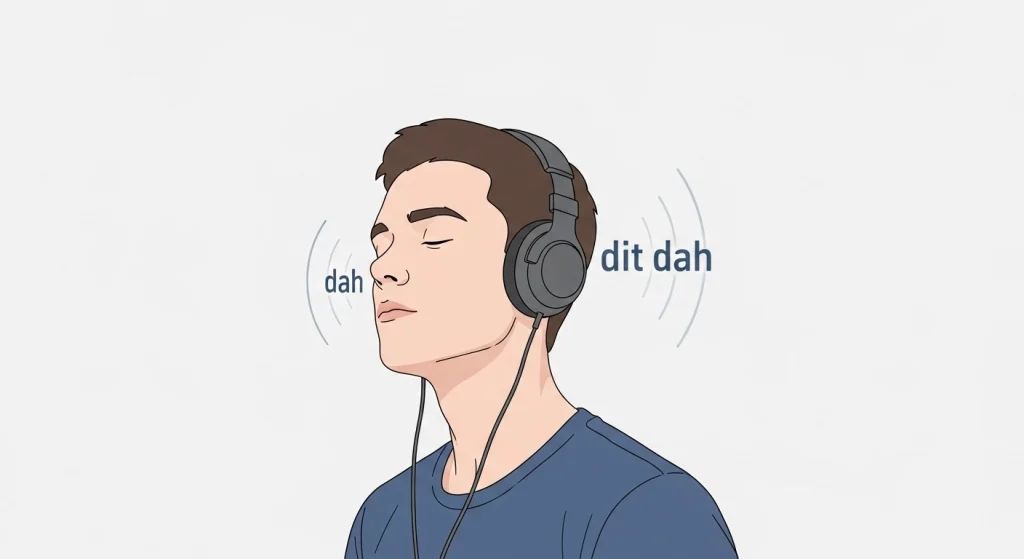
The goal is to hear each letter as a single sound unit, the way you hear spoken words. You do not hear individual phonemes when someone says “morning.” You hear the word. Morse fluency works the same way.
Start listening to Morse code recordings and try to identify characters without looking at the alphabet chart. It feels impossible at first. It stops feeling that way quickly.
Step 6: Practice at Realistic Speed Using the Farnsworth Method
The Farnsworth Method teaches each individual character at full speed but extends the gaps between letters and words. This trains your ear to hear characters correctly while giving you time to process each one.
Do not slow down the characters themselves to make things easier. That creates bad habits that become very hard to break later.
Is Morse Code Hard to Learn?
Learning the Morse code alphabet takes most people a few days of focused effort. Reaching a comfortable working speed, around five words per minute, typically takes four to eight weeks of daily sessions. That is faster than learning any spoken foreign language.
What Makes It Easier Than You Think
- The system is pattern-based, not grammar-based. There are no rules about sentence structure or verb conjugation.
- You only need to learn 26 letters, 10 numbers, and a handful of punctuation marks.
- Learning by sound is faster than learning by sight, and sound is something your brain picks up naturally.
- Short daily sessions of 10 minutes produce results faster than long, exhausting study blocks.
What Actually Takes Practice
- Timing. The spacing between signals, between letters, and between words is just as important as the signals themselves.
- Speed recognition. At slow speeds, you can count dots and dashes. At real speeds, you cannot. Moving past that counting habit takes deliberate effort.
- Shifting from visual to audio recognition. Most beginners try to read Morse. Fluent users hear it.
The International Morse Code Alphabet and Numbers
There are two versions of Morse code: American Morse code and International Morse code. This guide covers International Morse code, which became the global standard and is what you will encounter in every modern context.
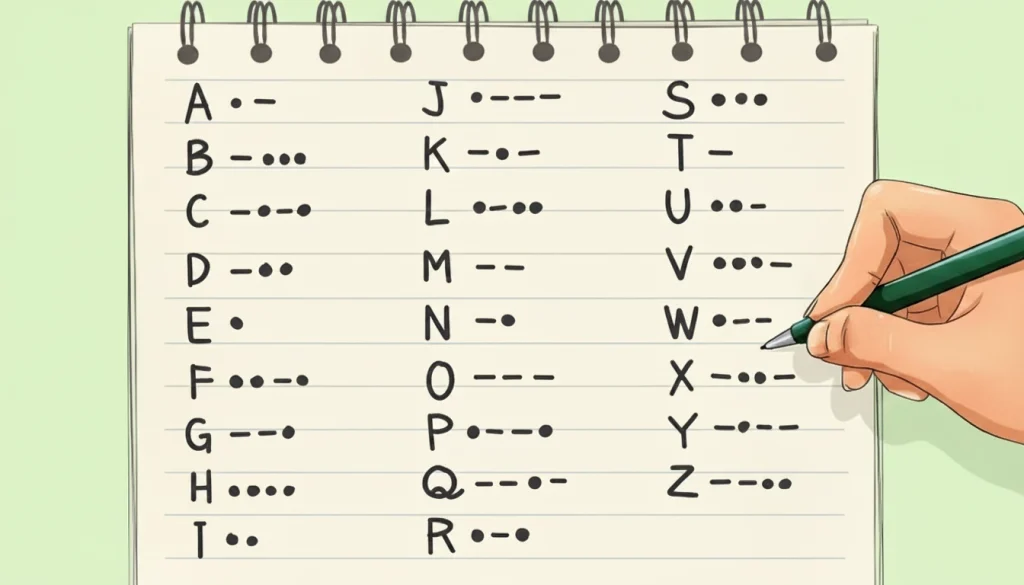
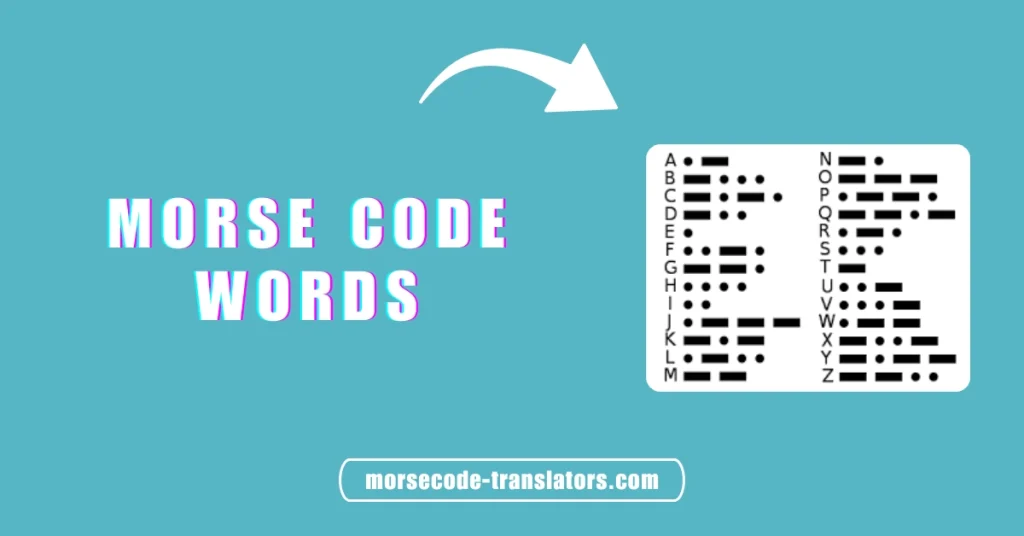
Full Morse Code Alphabet Chart
Letter | Morse Code | Letter | Morse Code |
A | · – | N | – · |
B | – · · · | O | – – – |
C | – · – · | P | · – – · |
D | – · · | Q | – – · – |
E | · | R | · – · |
F | · · – · | S | · · · |
G | – · | T | – |
H | · · · · | U | · · – |
I | · · | V | · · · – |
J | · – – – | W | · – – |
K | – · – | X | – · · – |
L | · – · · | Y | – · – – |
M | – – | Z | – – · · |
Numbers follow a clean logical pattern. From 1 to 5, each number gains one more dot. From 6 to 0, each number gains one more dash. Once you spot this pattern, the numbers become easy to remember.
Our Morse code numbers page breaks this down in more detail if you want to study numbers separately.
Number | Morse Code | Number | Morse Code |
1 | · – – – – | 6 | – · · · · |
2 | · · – – – | 7 | – – · · · |
3 | · · · – – | 8 | – – – · · |
4 | · · · · – | 9 | – – – – · |
5 | · · · · · | 0 | – – – – – |
Before you finish the full alphabet, it helps to learn a few high-value phrases. These give you real-world anchors as you practice.
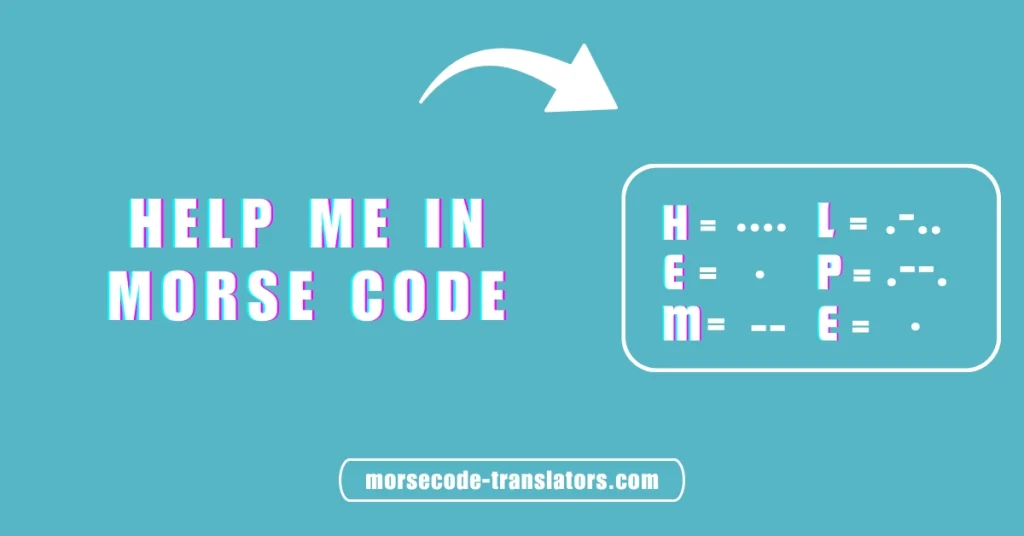
See our dedicated pages for SOS in Morse code, I love you in Morse code, and Help me in Morse code for full breakdowns including timing guides and audio references.
Word / Phrase | Morse Code |
SOS | · · · – – – · · · |
Hi | · · · · · · |
Help | · · · · · – · – – |
I Love You | · · – – – · – – – · – |
No | – · – – – |
OK | – – – – · – |
SOS deserves special mention. It is three dots, three dashes, three dots, sent as one continuous sequence without letter spacing. Learn this one first. It could matter in an actual emergency.
How Morse Code Timing and Rhythm Actually Work
Most beginner guides hand you the alphabet and move on. That misses the most important part of Morse code: timing. Without correct timing, your messages fall apart no matter how well you know the symbols.
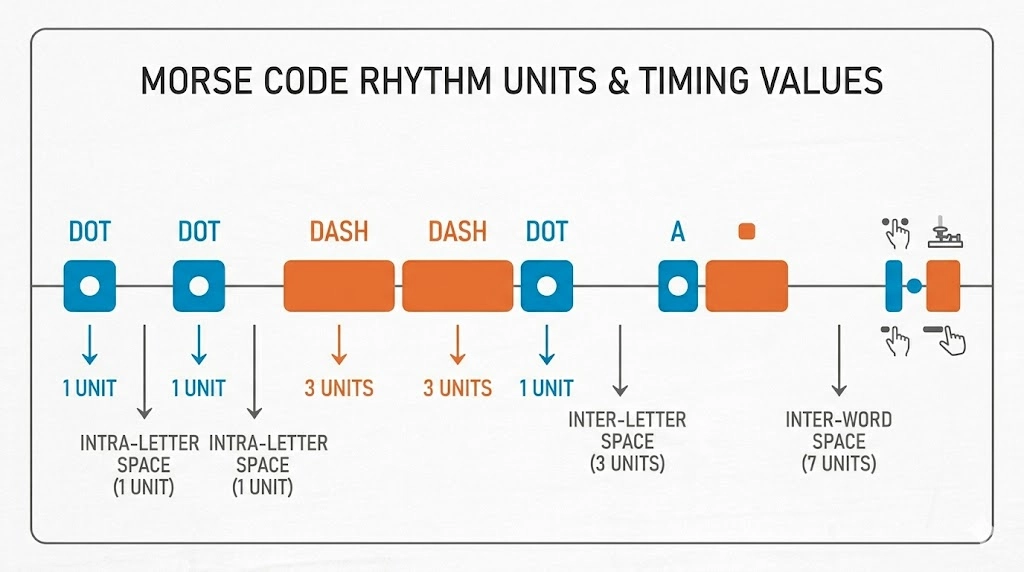
The Timing Units Every Learner Must Know
Element | Duration |
Dot (dit) | 1 unit |
Dash (dah) | 3 units |
The gap between signals within one letter | 1 unit |
Gap between letters | 3 units |
Gap between words | 7 units |
Think of it like music. The dots and dashes are notes. The gaps are rests. A message with perfect signals but wrong spacing sounds like a song played without rhythm. The meaning gets lost.
When you practice, treat the pauses with as much attention as the signals. Both carry meaning.
How to Sound Out Morse Code Correctly
Every letter in Morse code has a rhythm. Start saying the sounds out loud as you learn each character. Dits are short, clipped sounds. Days are held three times as long.
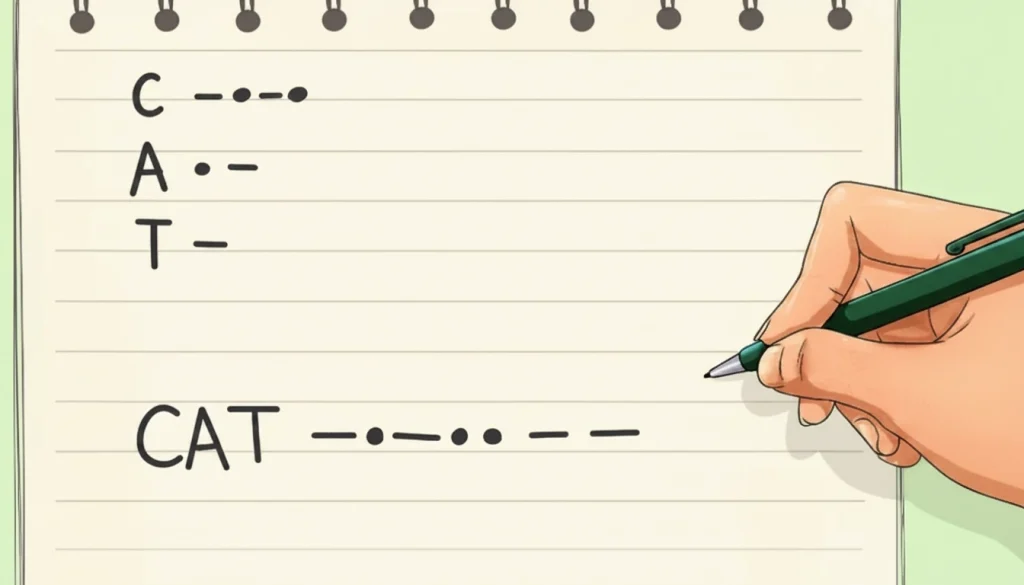
Word association helps here. Take the letter C, which is dah-dit-dah-dit. The word “catastrophic” matches that rhythm naturally: CA-tas-TROPH-ic. The stressed and unstressed syllables mirror the long-short-long-short pattern. Build your own associations using words that feel natural to you.
How to Learn Morse Code by Tapping
Tapping is one of the most underrated learning methods, and it does something that reading and listening cannot: it builds muscle memory.

What Tapping Practice Trains
When you tap out Morse code, your body learns the rhythm independently of your eyes and ears. This is the same principle behind a musician learning scales. After enough repetition, the patterns happen without conscious counting.
Tapping is also the closest you can get to using a real Morse key without buying equipment.
How to Tap Correctly
- Short, quick tap = dit
- Longer, held tap = dah
- Keep one beat between signals within the same letter
- Keep three beats between letters
- Keep seven beats between words
- Start with words you already know well before tapping new ones
- Use a pencil tip on a desk, your finger on a table, or tap on your phone screen
Using Your Phone as a Practice Key
Several mobile apps let you tap directly on the screen using haptic feedback. The short tap and long press map directly to dit and dah. This mirrors the original telegraph key experience closely enough to build real timing instincts.
Combine app-based tapping with pen-and-paper practice. Writing the symbols reinforces what your hands are learning from tapping.
The Best Ways to Learn Morse Code Fast
Speed in Morse code learning comes from the method, not from working harder. These techniques are consistently the ones that produce the fastest results.
Use the Word-Association (Mnemonic) Method
Match the rhythm of each letter to a word or phrase that starts with that letter and has the same stressed syllable pattern. Below are examples you can use or adapt.
Letter | Mnemonic Word | Morse Pattern |
C | catastrophic | – · – · |
G | gingerbread | – – · |
M | mailman | – – |
F | fiddlefern | · · – · |
B | bulldozer | – · · · |
P | prototype | · – – · |
D | dynamite | – · · |
W | wonderland | · – – |
Make your own for the letters where none of these feel natural. Personal associations stick better than borrowed ones.
Listen Daily, Even Passively
Put Morse code audio recordings on in the background while doing other things. You are not actively studying during this time. Your brain is just getting exposure to the rhythm and sounds. This passive listening accelerates active recall in ways that are hard to explain but very easy to experience.
Practice With Real Messages, Not Drills
Write your name in Morse code. Encode your grocery list. Tap out the names of people you know. Real content that you actually care about sticks in memory longer than random practice strings.
Follow a 10-Minute Daily Schedule
Short sessions beat long cramming. Here is a simple weekly plan that covers every core skill without exhausting you.
Day | Focus | Time |
Monday | Letters A to M (audio only) | 10 minutes |
Tuesday | Letters N to Z (audio only) | 10 minutes |
Wednesday | Numbers 0 to 9 | 10 minutes |
Thursday | Word building with known letters | 10 minutes |
Friday | Full short message decoding | 10 minutes |
Saturday | Tapping practice only | 10 minutes |
Sunday | Full review and speed drill | 10 minutes |
Stick to this for four weeks. The progress you see will surprise you.
Common Mistakes That Slow Morse Code Learners Down
Most learners hit the same walls. Knowing what they are before you hit them saves weeks of frustration.
Mistake | Why It Slows You Down | What to Do Instead |
Learning by sight only | Trains eye-reading, not ear recognition | Prioritize audio practice from day one |
Counting individual dots and dashes | Breaks rhythm and blocks fluency | Learn to hear each letter as one sound |
Learning all 26 letters before building words | Overloads short-term memory fast | Form words after your first 10 letters |
Practicing characters too slowly | Locks in habits that are hard to unlearn | Use the Farnsworth Method from the start |
Skipping spacing practice | Makes messages unreadable | Practice pauses as deliberately as signals |
Practicing irregularly | Progress resets between sessions | 10 minutes daily beats 90 minutes weekly |
If you are already making one of these mistakes, stop and correct it before continuing. Building on a bad habit takes more time to fix later than starting over correctly now.
Learn Morse Code Online: Tools and Resources
The internet gives you everything you need to learn Morse code without spending a cent. Knowing where to look matters more than having a budget.
Using a Morse Code Translator for Practice
Our Morse Code translator is one of the most practical tools you can use during the early stages of learning. Type any word or sentence, convert it instantly to Morse code, and then use the result as a decoding exercise. Run the process in reverse to check your encoding accuracy.
International Morse Code Standard Resources
The international Morse code system is documented and publicly maintained. Audio practice files based on this standard are freely available online and are organized by speed level, starting from very slow beginner paces and moving up to advanced rates.
Amateur Radio Communities
Once you reach basic fluency, amateur radio clubs are the best environment for live practice. Members range from beginners to highly experienced operators, and many clubs hold regular Morse code nets specifically for learners.
How to Use Morse Code in Real Situations
Knowing Morse code is one thing. Using it is another. Here are the situations where it actually applies.
Emergency Signalling With SOS
The SOS sequence is · · · – – – · · ·, sent as a continuous transmission without the standard letter spacing. You can send it using:
- A flashlight: short flashes for dots, long flashes for dashes
- A whistle: short blasts for dots, long blasts for dashes
- Tapping on a pipe or wall: short taps for dots, long taps for dashes
- Any reflective surface catching sunlight
Repeat the sequence with a short pause between each full SOS. Keep repeating until you get a response. Our SOS in Morse code page covers this in more detail, including signal duration guidelines.
Sending Messages to a Partner
Pick one other person to practice with. Agree on a simple message format and exchange short encoded notes. Texting in dots and dashes instead of letters is a genuinely fun daily habit that doubles as serious practice. Start with three-word messages and build from there.
Morse Code as an Accessibility Tool
Switch-based Morse input systems allow people with conditions that limit physical movement to communicate using just two inputs: a short press and a long press. These systems are integrated into assistive technology devices and give users full text input capability through Morse code alone.
Start Tapping: Your First Morse Code Message
Take your first name. Look up each letter in the alphabet chart above. Write out the dots and dashes. Then tap it out on your desk, short taps for dots and long taps for dashes. That is your first Morse code message.
It will feel slow and deliberate. That is exactly right. Every person who ever became fluent in Morse code started at that same slow, deliberate pace.
Use our Morse Code translator to verify your encoding. When it matches what you wrote, you have already taken the first real step. Come back tomorrow and do it again with a new word. That is the whole method. Show up daily. Keep sessions short. Trust the process.
Frequently Asked Questions
How do I teach myself Morse code?
Start with audio rather than visual practice. Learn the 10 most common letters first, build real words from those letters immediately, and practice tapping every day. Five to ten minutes of focused daily work produces steady, measurable progress.
Is Morse code easy to learn?
The full alphabet is learnable in one to two weeks for most people. Reaching a comfortable working speed takes four to eight weeks of consistent daily practice. Easier than any spoken foreign language.
How do you say "hi" in Morse?
HI in Morse code is · · · · · · — four dots for the letter H, followed by two dots for the letter I, with a three-unit gap between them.
What do 7 dots mean in Morse code?
Seven consecutive dots without any spacing are not a standard character in International Morse code. In normal transmission, the seven-unit gap represents the space between two words, not a signal itself. Seven dots appearing as a single run could indicate a transmission error.
Can I learn Morse code for free?
Yes, completely. Audio practice files, web-based training platforms, free mobile apps, and online communities all give you everything you need without spending anything. The only investment required is consistent time.
How can I learn Morse code quickly?
Combine three things: daily audio listening, tapping practice, and the mnemonic method for memorizing letters. That combination consistently produces faster results than any single method alone.
What does SOS look like in Morse code?
SOS is written as • • • — — — • • •. Three dots, three dashes, three dots, sent continuously with no gaps between the letters. It was chosen because its rhythm is unmistakable even under poor signal conditions.