SOS in Morse Code: Pattern, Sound, and How to Send It in Any Situation
You are out for a hike by yourself. Your phone runs out of power. You hurt your ankle about three miles from any roads. You have absolutely no idea of where you are. What do you have left? Just a flashlight and that faint memory of what you were once told: three dots, three dashes, and three dots.
This is the SOS signal using Morse code. In that very instant, you might very well find yourself wishing that those nine symbols are exactly what will get you rescued.
Most people know of SOS; however, there is a very slim chance that the same individuals are aware of how to send such a signal in a time of need. This is precisely why this article is meant to educate both beginners and experts in the art. From how you can send it, its meaning, origin, and even sending it without equipment, this guide has you covered.

Does SOS Actually Stand for Something?
Here is the most common myth about this signal: that SOS stands for “Save Our Souls” or “Save Our Ship.” Both phrases are catchy. Both are completely made up after the fact.
These are called backronyms. Someone took an existing abbreviation and retrofitted words onto it to make it memorable. The truth is that SOS was never meant to stand for anything at all.
The signal was chosen purely for its pattern. Three dots and three dashes are among the most basic signals in international Morse code. They are easy to produce under extreme stress, easy to recognise in poor conditions, and impossible to confuse with routine communication. That is the entire reason this sequence was selected.
In fact, there could also have been an interpretation of the same Morse code as EEETTTEEE, VTB, or some other series of letters. However, the combination of S, O, S was the easiest one to remember and understand; therefore, its name has remained unchanged up until now.

4 Methods to Do SOS Morse Code

By Sound: Whistle, Tapping, or Radio
- Blow or tap three short signals
- Follow immediately with three long signals
- End with three short signals again
- Pause for a few seconds, then repeat
- Keep the rhythm consistent rather than fast
This works on any surface: a rock, a wall, a pipe, a metal railing. Three quick taps, three slow taps, three quick taps. Simple.
By Light: SOS in Morse Code Light Signals
- Short flash for dot (roughly 1 second on)
- Long flash for dash (roughly 3 seconds on)
- 1 second off between each flash
- Pause for 7 seconds between full cycles
- Aim toward open sky, water, or distant high ground
Point a flashlight, a signal mirror, or even a phone screen toward where help might come from. SOS in Morse code light signals are particularly effective at night over open water or in mountain terrain.
Blinking: SOS in Morse Code Blinking
When sound is not an option, blinking works. Car headlights, a torch pressed against a window, a signal lamp on a boat. You can even use a smartphone screen facing upward as a visual beacon in low-light situations.
The key with blinking is pacing. When you are stressed, your instinct is to rush. Count in your head: one for a dot, one-two-three for a dash. Slow and deliberate is more readable than fast and frantic.
Written or Ground Display
Spelling out SOS in large letters on the ground works for aerial rescue. Sand, snow, rocks, fallen branches, coloured fabric: all of these work. Make each letter at least three metres tall if possible. Use contrast: dark rocks on pale sand, bright fabric on dark earth.
One practical advantage of the letters SOS specifically is that they read the same way right-side up and upside down. A rescue pilot flying in either direction will read them correctly.
How to Say SOS in Morse Code
If you have ever wondered how to say SOS en code Morse out loud, the phonetic pronunciation used by radio operators is:
di-di-dit, dah-dah-dah, di-di-dit
“Di” represents a dot. “Dah” represents a dash. The final “dit” in the S segments signals the end of that letter cluster. Say it fast a few times, and you will start to hear the rhythm.
When you are actually transmitting, here is how the timing works:
- A dot lasts 1 unit
- A dash lasts 3 units
- The gap between signals within the same letter is 1 unit
- Because SOS is a prosign, there is no inter-letter gap at all
- The gap between two full SOS cycles is 7 units
At a comfortable beginner speed, one unit is roughly one second. So a dot is a quick tap, and a dash is a slow three-count. Once you get that timing into your muscle memory, sending SOS becomes almost automatic.
Want to hear what it actually sounds like? Use our Morse Code Translator to play the audio and practice recognising the pattern before you ever need it in a real situation.
What Does the SOS Sound in Morse Code Actually Sound Like?
This section matters more than most people realise. Transmitting SOS incorrectly is one of the most common beginner mistakes. Hearing it correctly is what allows rescuers, ham radio operators, and nearby vessels to respond.
The SOS sound in Morse code has a very specific rhythm. Short-short-short pause long-long-long pause short-short-short. Even without knowing anything about Morse code, a person who hears this pattern three or four times in a row will register that something is unusual. That is intentional design.
At normal transmission speed, the entire signal takes roughly three to four seconds. At a slow, deliberate pace for beginners, it takes around nine seconds. Either way, it stands out against normal radio traffic or background noise because of the alternating short-long-short structure. No standard word or phrase in Morse produces that particular rhythm.
This is also why the signal works as well with a whistle as it does over a radio. The pattern is what communicates urgency, not the medium.
Other Morse Distress Signals Worth Knowing
SOS gets all the attention, but it is worth knowing that it was not always the only distress signal in use.
1. CQD
was the original maritime distress call before SOS was standardised. CQ was a general broadcast meaning “all stations listen.” Adding D indicated danger. It was sent as three separate letters, not a prosign, which made it easier to confuse with regular traffic. That weakness was exactly why SOS replaced it.
2. CQ
without the D is still actively used in amateur radio today. It is a general call inviting any station to respond, not a distress signal. If you are getting into ham radio, you will hear CQ regularly.
3. Help in Morse code
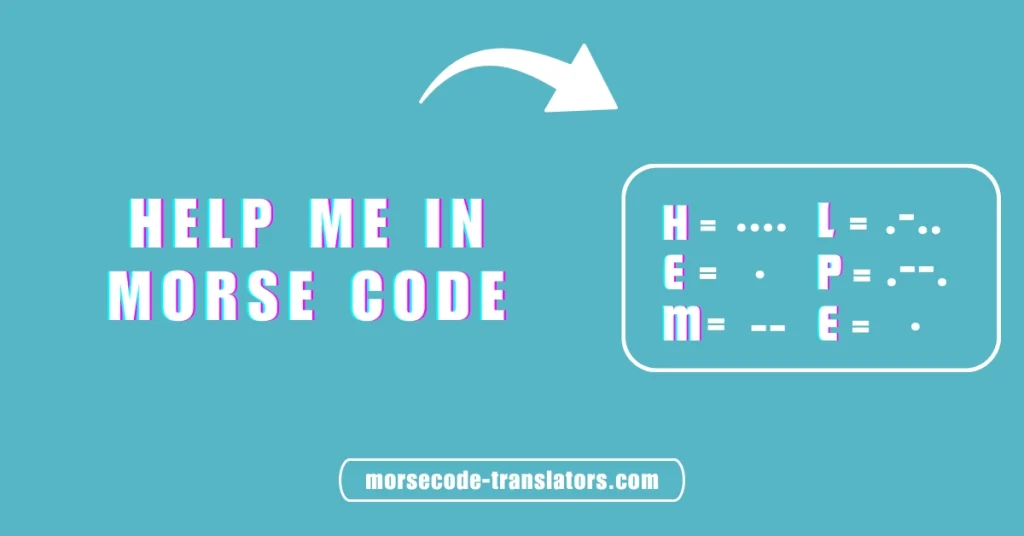
is another phrase worth knowing. The letters H · · · ·, E ·, L · — · ·, P · — — · give you a recognisable word that some operators use alongside SOS to provide additional context. You can look at Help me in Morse code on our site for the full breakdown.
Knowing these gives you a broader toolkit in emergency situations, and it also makes you a more informed learner as you progress through the full Morse code alphabets.
SOS vs Mayday: What Is the Difference?
This is one of the most commonly asked questions about distress signals, and the answer clears up a lot of confusion.
SOS was never actually replaced by Mayday. They served completely different purposes and different communication channels.
Mayday is a spoken distress call. The word comes from the French phrase “m’aider,” which translates roughly as “help me.” It was introduced for use in voice radio communications, which became widespread in aviation during the 1920s and 1930s. When pilots needed to call for help over a radio they spoke into rather than tapped on, they needed a vocal equivalent of SOS.
SOS remained the standard for Morse code and visual signalling. Mayday became the standard for voice radio. As telegraphy was gradually replaced by voice radio as the primary communication medium, Mayday became more widely known. But SOS was never formally abolished as a distress signal, and it remains valid and recognised today.
So the short version: SOS is for tapping, blinking, and visual signals. Mayday is for voice calls. Knowing the difference matters, especially if you are learning how to learn Morse code for practical survival or amateur radio use.
Morse Code for SOS in the Modern World
At first glance, you may ask yourself if all of this applies in today’s time of smartphones, GPS, and satellite communication. And, to be frank, it does, in a variety of ways.
In the modern phone, you have the capability of activating an Emergency SOS function. In some modern phones, when you press down the side button, the phone automatically calls for help and also broadcasts your GPS coordinates. If you are lucky enough to have a model that can connect using satellites, then it will use the same method when cellular service is unavailable. In essence, you are doing the same thing in 2013 as radio operators did in 1908.
When sailors, pilots, or mountaineers use GPS distress beacons, which are required pieces of equipment on many commercial ships and are very common with adventurers, they send a signal similar to SOS.
But here is the thing about technology. It fails. Batteries die. Satellites lose signal. Devices get soaked or dropped. When all of that happens, the person who knows how to tap three short, three long, three short on a rock or flash a torch in a rhythmic pattern still has an option. The person who does not is simply out of options.
This is why organisations that train sailors, pilots, and wilderness guides still teach manual Morse SOS. It is not nostalgia. It is a genuine backup.
What Is SOS in Morse Code?
The Morse code for SOS looks like this: · · · — — — · · ·. This is three dots, three dashes, and another three dots. Pretty simple in writing.
However, there is something that many people misunderstand about SOS. The message is not sent by sending an S, an O, and then an S with spaces between each. Instead, it is considered a prosign and is sent out all at once. In formal notation, it is sometimes written as <SOS>.
Why does that distinction matter? Because if you send S · · · then pause, then O — — — then pause, then S · · · with spaces, you are technically sending three separate letters. That changes the rhythm. A trained operator or rescue team listening for the distress signal may not recognise it the same way.
The correct SOS code in Morse looks and sounds like this:
Signal | Representation | Duration |
S (first) | · · · | 3 short signals |
O | — — — | 3 long signals |
S (second) | · · · | 3 short signals |
Full SOS Prosign | · · · — — — · · · | Continuous, no gaps between letters |
Pause between cycles | Silence | Roughly 7 units before repeating |
You keep repeating the cycle with a short pause between each full round until someone responds.
Practise Sending SOS: A Beginner Quick-Start
You do not need any equipment to start learning this. Your fingers and a table are enough.
Start with just the rhythm. Short-short-short. Long-long-long. Short-short-short. Tap it on your desk right now. Do it ten times until you stop having to think about it.
Then add the timing. A dot is one quick tap. A dash is a three-count tap. Between each full SOS cycle, pause for about seven counts before starting again.
Once that feels natural, use our Morse Code Translator to listen to the audio and compare it to your own tapping. You will hear immediately if your dashes are too short or your rhythm is off.
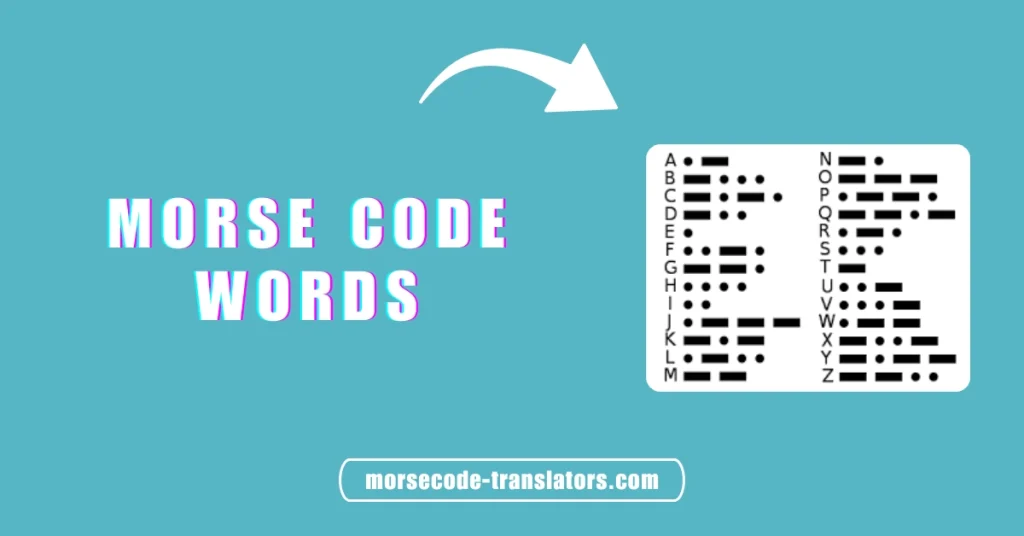
From there, you can start building out your full Morse knowledge. Learning Morse code numbers alongside the alphabet gives you the ability to communicate coordinates, which is genuinely useful in navigation situations. Practising Morse code words builds speed and recognition. The SOS pattern is just the beginning.
You can also explore specific phrases like I love you in Morse code or Help me in Morse code as practice targets since these are short, emotionally memorable, and use a good mix of common letters.
The Real History of SOS as a Distress Signal
The German government addressed this in 1905 by introducing the SOS signal in its radio regulations, which became effective on the 1st of April that year. A year later, the second International Radiotelegraphic Convention met, and representatives signed an agreement adopting SOS as the worldwide standard. That agreement became effective on the 1st of July 1908.
The requirement was specific: ships in distress were to use the signal · · · — — — · · · repeated at brief intervals. Importantly, the convention also specified that international Morse code should be used rather than American Morse code, which used different symbols for some characters.
Then came 1912 and the Titanic. The ship’s wireless operators transmitted both CQD and SOS in the hours after striking the iceberg. It was one of the first real-world high-profile uses of the SOS signal, and it cemented the call’s place in public consciousness permanently. Both signals were used because operators were trained in both, and in a life-or-death situation, they used everything available.
During the First and Second World Wars, SOS Morse code played a direct role in coordinating rescues for sinking vessels and downed aircraft across both the Atlantic and Pacific Oceans. Hundreds of lives were saved specifically because the signal was standardised, recognisable, and simple enough to transmit under duress.
Frequently Asked Questions
Does SOS mean "Save Our Souls"?
No. SOS is not an acronym for anything. “Save Our Souls” and “Save Our Ship” are backronyms. SOS was selected purely because its Morse pattern, three dots, three dashes, three dots, is simple, distinct, and easy to transmit under pressure.
What does 3 dots mean in Morse code?
Three dots in Morse code represent the letter S. In the SOS distress signal specifically, three dots appear at both the beginning and end of the sequence, surrounding three dashes in the middle.
How to tap SOS in Morse code?
Tap three times quickly (dots), then three times slowly with a three-count hold each (dashes), then three times quickly again (dots). Pause for about seven counts, then repeat.
How do you say SOS in Morse code?
Phonetically, Morse operators say: di-di-dit, dah-dah-dah, di-di-dit. The “di” sound is a dot, the “dah” sound is a dash, and the “dit” ending marks the close of the S letter clusters.
Why was SOS changed to Mayday?
SOS was not replaced. Mayday was introduced as a separate distress call for voice radio communications, coming from the French phrase “m’aider” meaning “help me.” SOS remained valid for Morse code and visual signals and technically still is today.
How do you send an SOS with a flashlight?
Three short flashes (about 1 second each), three long flashes (about 3 seconds each), three short flashes again. Pause for 7 seconds between full cycles and repeat. Aim toward open sky or in the direction of expected help.
What is the SOS code in Morse?
The Morse code SOS pattern is · · · — — — · · ·. Three dots, three dashes, three dots, transmitted as one unbroken prosign.