Morse Code Numbers: Complete Chart, Patterns, and Learning Guide (0–9)
You have a number to send. Maybe it is a date, a coordinate, a phone number, or a distress signal with a timestamp. Of course, you are already aware that Morse code includes alphabetic characters, but do you know anything about the numeric side? Is there something such as Morse code numbers? Do they have the same rules as letters?
This is precisely the kind of information everyone looks up when they find themselves at this juncture. What they are looking for is a definite answer, a solid chart, and a practical way forward. Luckily for you, the Morse code numbers have one of the most sensible structures within the system itself. Once you understand it, there’s no going back.
This Morse code numbers guide covers everything, from the Morse code numbers chart to Morse code 1, Morse code 2, Morse code 4, and more. We discuss how to code and decode, the best learning methods, and much more. You can always use our Morse Code Translator whenever you wish to practice, check your answers, or simply translate any number into Morse code.

Morse Code Numbers Chart (0–9)
Digit | Morse Code | Signal Breakdown | Memory Hook |
0 | – – – – – | 5 dashes | Five long train whistles |
1 | · – – – – | 1 dot, 4 dashes | One lighthouse flash, then long silence |
2 | · · – – – | 2 dots, 3 dashes | Two quick knocks, then three long holds |
3 | · · · – – | 3 dots, 2 dashes | Three short taps, two slow ones |
4 | · · · · – | 4 dots, 1 dash | Four fast clicks and one slow stop |
5 | · · · · · | 5 dots | Five equal camera clicks |
6 | – · · · · | 1 dash, 4 dots | One long wave, then four ripples |
7 | – – · · · | 2 dashes, 3 dots | Two long steps, three short ones |
8 | – – – · · | 3 dashes, 2 dots | Three long tones, two short endings |
9 | – – – – · | 4 dashes, 1 dot | Almost silent, one small dot at the end |
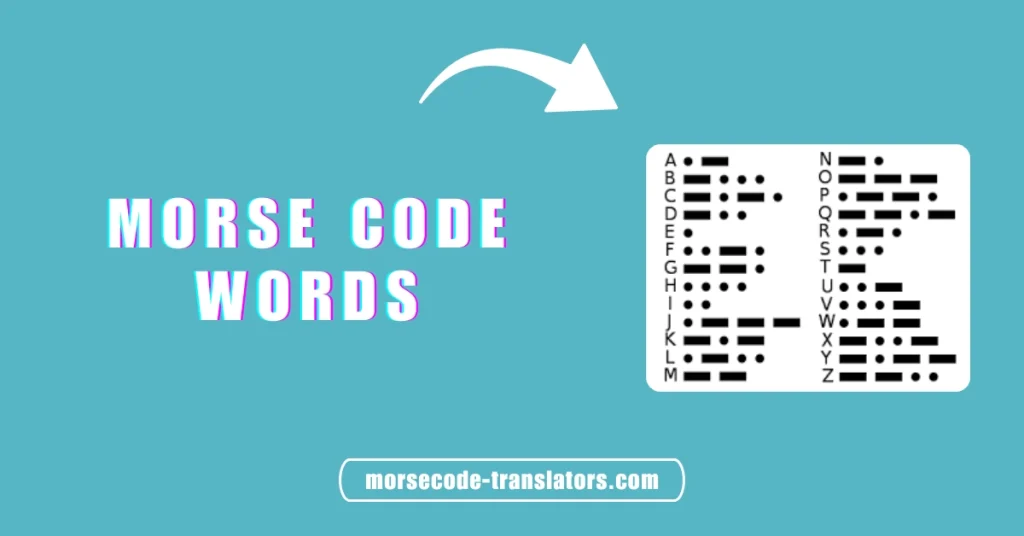
You will frequently find numbers mixed with common Morse code words in amateur radio transmissions.

How to Learn Morse Code Numbers Fast

Phase 1: Memorise the Pattern, Not Ten Codes
Do not try to memorise ten separate sequences. That is the slow way. Learn the seesaw rule instead:
- 1 through 5: dots fill from the left, dashes fill from the right
- 6 through 0: dashes fill from the left, dots fill from the right
- 5 is all dots, 0 is all dashes
Spend five minutes with the chart using this rule and you will have a solid foundation for all ten digits. The memory hooks in the chart above help lock each one in more concretely. Attach a personal image to each number; something silly or specific tends to stick better than something generic.
Phase 2: Train Your Ear
Morse code was built to be heard, not read. Learning it visually first is fine, but audio training is what builds real speed. The rhythm of a number is what your brain eventually learns to recognise automatically, not the individual dots and dashes.
Start with contrast pairs. Practice 1 and 0 together since they are the most different sounds in the system. Then try 2 and 8, 3 and 7, 4 and 6. These pairs share the same signals in opposite order, so training them as pairs sharpens recognition faster.
Use the Morse Code Translator audio feature to play any number at different speeds. Start slow, slower than feels necessary. The Farnsworth method (normal signal speed, slower gaps) is especially effective for building pattern recognition without building a counting habit.
Phase 3: Practice with Real Numbers
Once the patterns feel familiar, start encoding numbers that mean something to you:
- Your birth year
- Today’s date
- A phone number or zip code
- A meaningful coordinate
Decoding something you already know the answer to builds confidence fast. Once you feel comfortable with digits alone, move into Morse Code Words practice to combine numbers and letters in real message formats.
Memorizing digits is a crucial step when figuring out how to learn Morse code efficiently.
How to Encode Numbers in Morse Code
Encoding numbers in morse code for numbers is a three-step process.
- Break the number into single digits: treat each digit as its own unit
- Replace each digit using the chart: apply the five-signal pattern for each one
- Add pauses between digits: one unit of silence between signals within a digit, three units of silence between separate digits
Worked example 1: Encoding a phone number prefix: 305
- 3 = · · · – –
- 0 = – – – – –
- 5 = · · · · ·
Full sequence: · · · – – / – – – – – / · · · · ·
Worked example 2: Encoding a year: 1997
- 1 = · – – – –
- 9 = – – – – ·
- 9 = – – – – ·
- 7 = – – · · ·
Full sequence: · – – – – / – – – – · / – – – – · / – – · · ·
The spacing between digits is just as important as the signals themselves. Without proper pauses, two separate digits collapse into one unreadable sequence.
Morse Code Numbers 1 to 100
Morse code numbers 1 to 10 are the most commonly searched range because they cover the foundation of everything. Morse code numbers 1 to 100 follow the exact same logic. Every number, no matter how large, is built from the same ten-digit codes. You never need new symbols.
For any two-digit number, encode the tens digit first, pause, then the units digit. For 100, encode each digit: 1, 0, 0.
Number | Morse Code |
10 | · – – – – / – – – – – |
25 | · · – – – / · · · · · |
50 | · · · · · / – – – – – |
73 | – – · · · / · · · – – |
100 | · – – – – / – – – – – / – – – – – |
The Morse Code Translator on this site converts any number instantly, so you can check your work or generate practice sets for any range, including 1 to 100 and beyond.
Are There Numbers in Morse Code?
Yes, absolutely. Every digit from 0 to 9 has its own dedicated code in the International Morse Code system, standardised by the International Telecommunication Union (ITU). Numbers were actually part of Samuel Morse’s original concept; he initially designed the system to transmit only numerals, with a codebook to decode their meaning. Letters were added later.
Today, numbers in Morse code are used by amateur radio operators, aviation technicians, maritime communicators, and emergency responders worldwide. They follow a completely different structure from Morse Code Alphabets, which makes them easy to identify once you know the rules.
Individual Number Breakdowns
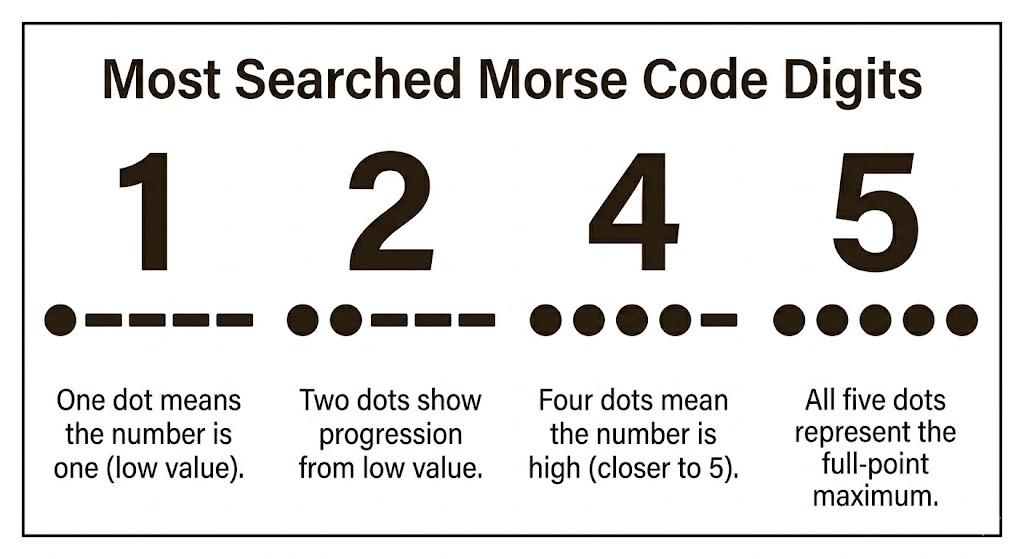
These four digits come up the most in search because people need a quick reference for specific numbers. Here is each one in detail.
1 in Morse Code (· – – – –)
Morse code 1 is one dot followed by four dashes. The contrast is sharp, one very short signal, then four long ones. That contrast actually makes it one of the easier digits to recognise by ear. The rhythm sounds like: dit — dah dah dah dah.
2 in Morse Code (· · – – –)
2 in Morse code is two dots, then three dashes. The rhythm splits evenly between short and long: dit dit — dah dah dah. When you hear two quick signals before a series of slow ones, you are almost certainly hearing a 2.
4 in Morse Code (· · · · –)
4 in Morse code is four dots followed by a single dash. It sounds rapid at first, then ends with one long hold. Four fast, one slow. The rhythm is easy to spot because nearly everything comes out quickly before that final pause-and-hold.
5 in Morse Code (· · · · ·)
Five equal dots. No dashes at all. The simplest and most rhythmically consistent digit in the entire system. Five identical short signals in a row. Once you hear it once, you recognize it every time after.
How Morse Code Numbers Work
Letters in Morse code use anywhere from one to four signals. Numbers are different. Every single digit, from 0 to 9, uses exactly five signals. That is the first rule to lock in.
A signal is either a dot or a dash. A dot is a short transmission. A dash is three times the length of a dot. The gap between signals inside the same character is one dot long. The gap between two separate digits is three dot lengths. Get the spacing right, and decoding becomes much easier.
The Five-Signal Rule
Every number in Morse code has exactly five parts. No more, no less. This is what separates numbers from letters in a real transmission. If you are listening to a signal and you count five elements before the pause, you are hearing a number. This rule alone solves one of the most common decoding mistakes beginners make.
The Seesaw Pattern
Here is where numbers in Morse code become genuinely easy to learn. Think of a seesaw:
- Numbers 1 through 5 start with dots on the left and end with dashes. The number of dots tells you which digit it is.
- Numbers 6 through 0 flip this completely. They start with dashes and end with dots. The number of dashes tells you which digit, and for 0, all five signals are dashes.
- Number 5 is right in the middle: five dots, nothing else. Number 0 is at the opposite end: five dashes, nothing else.
This single pattern covers all ten digits. You do not need to memorise ten separate codes. You need to remember one rule and count.
How to Read Morse Code Numbers
Decoding by Sound
When decoding Morse code numbers by ear, the first signal tells you which half of the table you are in. If the sequence starts with a dot, the digit is somewhere between 1 and 5. If it starts with a dash, you are looking at 6, 7, 8, 9, or 0.
From there, count the total number of dots or dashes at the front of the sequence.
- Starts with 2 dots → 2
- Starts with 3 dashes → 8
- All dashes, five total → 0
With a little practice, this becomes fast and instinctive. You stop counting and start hearing patterns.
How to Read Morse Code, Light Numbers
Reading morse code light numbers uses the same patterns as audio decoding, but through visual flashes instead of sound. A short blink is a dot. A long blink lasting roughly three times as long is a dash.
Maritime signal lamps, flashlights, and emergency strobes all use this method. If you are in a situation where voice communication is not possible, knowing how to send and read Morse numbers through light can be genuinely useful. A stranded person can flash coordinates, a time, or a distress sequence using nothing but a torch.
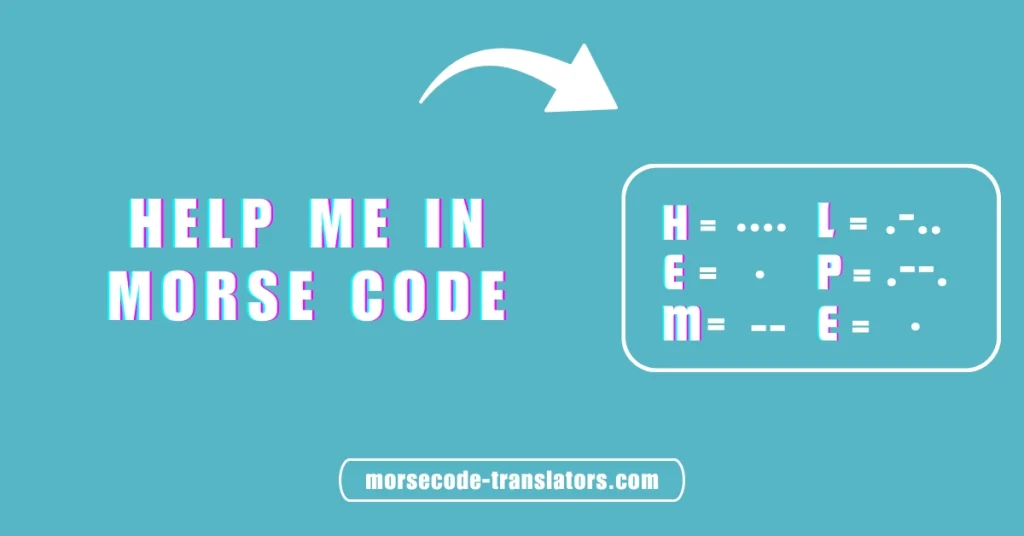
This is exactly where Morse code numbers connect directly to emergency skills. For the distress signal itself, see the SOS in Morse Code guide. For a full distress phrase, Help me in Morse Code covers the complete sequence.

Decoding on Paper
When writing out received signals, use a slash between digits to keep them separate. Always count to five before closing a digit. If your count reaches five and you have a valid pattern, write it down and start fresh for the next one.
Example notation: · – – – – / · · – – – / · · · – – = 1, 2, 3
Common Mistakes When Reading and Writing Morse Code Numbers
Mistake 1: Confusing numbers with letters
The letter H is four dots (· · · ·). The number 5 is five dots (· · · · ·). At speed, these can sound similar if your counting is off. The fix is the five-signal rule. If you count fewer than five signals, it is a letter. Always count before committing to a digit.
Similarly, the letter A is · –, which shares signals with the beginning of 1 (· – – – –). Context matters. If you are in a portion of the message that should contain a number — coordinates, a date or a frequency, treat it as one.
Mistake 2: Timing errors that collapse two digits into one
Without proper spacing, the sequence for “12” (· – – – – / · · – – –) can blur into something unreadable. The pause between digits must be clearly three times the length of a dot. Rushed sending is the most common cause of decoding errors. When practicing with a key or tapper, slow down before you speed up. Accuracy first, speed later.
Mistake 3: Mixing up 6 and 1, or 9 and 0
These pairs look and sound similar because they share the same number of repeated signals. 1 is · – – – – and 6 is – · · · ·. At slow speeds the difference is obvious. At high speed, the first signal is the only thing that separates them. Train those first signals deliberately as contrast pairs.
Using the Morse Code Translator for Number Practice
The Morse Code Translator is the fastest way to practice, verify, and build fluency with morse code numbers. Here is how to use it:
- Encode any number: Type any digit or sequence into the input field and see the Morse code appear instantly
- Decode Morse sequences: Paste dots and dashes into the decoder to convert them back to digits
- Use audio playback: Hear any number played at adjustable speeds to train your ear
- Generate practice sets: Enter random numbers like your phone number, birth year, or today’s date and practice decoding them back
- Verify your work: After encoding manually with the chart, cross-check with the translator to confirm accuracy
Application of Morse Code Numbers
Amateur (Ham) Radio
Ham radio operators use a reporting system called RST (Readability, Strength, Tone) to describe signal quality. Operators send numbers like “599” in Morse code to indicate a perfect signal. This is still in active daily use worldwide. With roughly 700 Morse practitioners in Australia alone as of late 2025, the community remains active. The International Morse Code system is the standard all operators follow.
Aviation Navigation Beacons
Non-Directional Beacons (NDBs) around the world still transmit their station identifiers in Morse code, including numeric sequences. Pilots learn to identify these signals. Aviation authorities require trainees to recognize Morse-coded identifiers as part of instrument navigation training.
Emergency Signaling
In real emergencies, Morse code numbers carry coordinates, times, and critical figures that a rescue team needs. A distress call is not just SOS; it often includes a location in numeric form. Knowing how to transmit your GPS coordinates in Morse can mean the difference between being found and being lost.
Assistive Communication Technology
Single-switch Morse input devices allow people with severe motor disabilities to communicate by tapping or pressing a single button. The system encodes every character, including all numbers, through rhythmic input. Numbers are often the first characters taught in this context because the seesaw pattern makes them faster to learn than the full alphabet.
Hobbyist and Personal Use
Morse code numbers appear in jewelry, tattoos, and personalized gifts all the time. Birth years, anniversaries, and meaningful dates: encoding these in Morse creates something personal and private. If you want to check or create one, the Morse Code Translator handles any numeric input instantly.
For meaningful phrases to pair with numbers, explore I love you in Morse code, and Morse code words for ideas.
Frequently Asked Questions
What is Morse code for numbers?
Morse code for numbers is a set of five-signal patterns representing digits 0 through 9. Numbers 1 to 5 begin with dots and end with dashes. Numbers 6 to 0 begin with dashes and end with dots. The digit 5 is five dots and 0 is five dashes.
How do you write numbers in Morse code?
Break the number into individual digits. Replace each digit with its five-signal code from the chart. Separate each digit with a pause three times the length of a dot. For example, 42 is encoded as · · · · – (for 4), pause, · · – – – (for 2).
Is 1 in Morse code one dot or one dash?
1 in Morse code is one dot followed by four dashes: · – – – –. It is not to be confused with the letter A (· –), which uses only two signals.
What is 2 in Morse code?
2 in Morse code is two dots followed by three dashes: · · – – –. The first two signals are short, the last three are long.
What is 4 in Morse code?
4 in Morse code is four dots followed by one dash: · · · · –. Most of the sequence is rapid dots, ending with a single long signal.
Can you send Morse code numbers with a flashlight?
Yes. Short blinks represent dots and long blinks represent dashes. Apply the same five-signal patterns. A long blink should last roughly three times as long as a short blink.
How long does it take to learn Morse code numbers?
With the seesaw pattern and five to ten minutes of daily practice, most people can memorize all ten digits within three to five days. Adding audio training cuts that time significantly.
Are Morse code numbers the same worldwide?
Yes. The International Morse Code standardized by the ITU defines the same digit codes for 0 through 9 used globally. Every amateur radio operator, aviation authority, and maritime communicator follows the same system.
What is morse code numbers 1 to 100?
Numbers 1 to 100 use the same digit codes stacked in sequence. Each digit gets its own five-signal block. The number 73, for example, is the code for 7 followed by the code for 3.